Showing posts with label fastingnotfeasting. Show all posts

15.4.13

Creativity and repetition: Happy Boishakh bitchin and Ramadan revolution to you all

The Bangla New Year was sung in through Bangladesh, from Dhaka down, with a colourful ritual fervour and much drawing room chatter. In these post Shahbag times and in the last months of the present regime, Pohela Boishakh serves as agrarian symbolic relief for urbanites and a spectacle for cultural nationalist values to wrap around and express.

I guess that during Pakistan times, Boishakh in this form was an important space for opposition cultural forces. Therefore a lot of what we see is a hangover from that period turned into state cultural policy, normalised by much of the middle-class, denuded of meaning by consumerism and historical amnesia, and rejected by competing political frames.

The students of the Charukola Art establishment, as usual, worked hard to create a menagerie of beautiful floats and masks. Some, like the one pictured below kinda scare my pants off.  Alas, I should not be afraid, as these are not political aesthetics in translation, snakes are created beings with rights, community and a definitive symbolic roles to play in religious ecosystems.
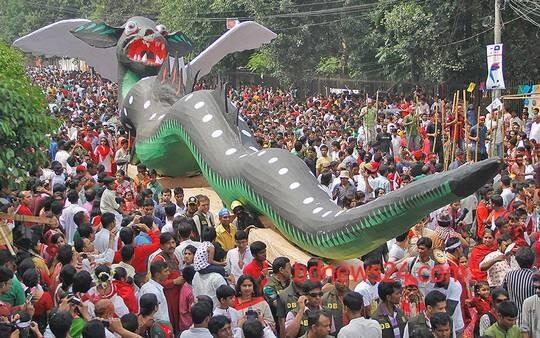
Source: @danieltweetin
Directed dietary acts, singing, and creativity create a political self, they are important to understand and resculpt if we are to produce an active political and spiritual self.

All to often we can miss the point altogether. In the words of national treasure Hyder Husyn, a pious folk-rocker with social conscience, reflecting on  national independence in his wonderful song 30 Bochor (Years)
Does freedom mean eating slightly fermented rice and hilsa fish at Bangla New Year Fairs? 
Does freedom mean sitting under the banyan tree and singing Bangla New Year songs? 
Music isn't haram, especially this. 

My favourite, constructive contribution was the senior water sector engineer Inamul Haque's (re)call for the fiscal year to start and end around Bangla New Year. This single bureaucratic change would enable the success of all engineering works in Bangladesh, by scheduling expenditure and physical development works away from flood times and denying a whole lot of excuse-making. Peoples lives, homes and livelihoods would be better protected from river erosion, coastal erosion and flood, who knows the possible beneficial impacts on land making and other sectors.

Muhajirs from Boishakh?

Like many other calenders in the region that bear ethno taglines, the Bangla calender draws from King Akbar's solarisation of the lunar Hijri calender that marks RasulUllahs migration to Medina from the oppression of Makkah. Visiting the cities for Hajj last year it was like divine geological poetry that Makkah resembled a clenched fist and Medina an open palm.

I don't buy the universal pretensions of status quo Boishakh. From inside and outside of me I observe that it is aesthetically and politically alienating of differently Islamically inclined political subjects of the state, who annually chafe through the day like a haji in an ihram on a hot day with inadequate ventilation. Yet the 'Boishakh as Hindu Culture' pejorative, though understandable, doesn't generate any creative work and worse still distracts the Muslim from the cultural stagnancy of Islam in Bangladesh.

Its not that young folks aren't interested in Islah, more that there are insufficient socio-cultural guides, audiences and spiritual-political protections to enable the processes of self-discovery and awkward experimentation.

This morning I watched a few videos from the folks at ibana group, these were pretty cute and were produced well.  My heart screamed mashallah, my head retorted Salafi Triangle, but my practical sensibility respects how much this is relevant to the religious literacy issue in Bangladesh. The Maher Khan story depicts the journey of a middling heavy metal guitarist away from his music into a non musical 'more' Islamic present.  Personally, I am hungry for a re-imagined metal that thrashes the forces and structures of injustice, tyranny and consumer capitalism, and pray that we haven't heard the last of Maher bhai. Maybe I should stop living vicariously through the lives of others.

If you were wondering about The Salafi Triangle, it is a shorthand for why a lot of Islamic works have taken their present shape. The frame is intended to explain, not detain.

Source: The Developmentia Project, see also: neoliberal salafism


Pantha bhat is to Boishakh, what Piaju is to Ramadan

On the subject of analysis of the political and Islamic self, lets talk about Ramadan. This year Ramadan will arrive around 9th July and take us through to the beginning of August, as ever it is what we make of it and we'll be sorry to see it go.  This won't be a relevelation to some but, much of what has happened to Boishakh has happened to Ramadan, political reduction, consumerisation and mattabarisation.  It would appear that the middle-class probably has a lot to answer for. 

Boishakh: Pantha bhat, ilish mas and green chilli
Reclaiming Ramadan from the market, state and mislamist liberates the Muslim self, and makes fresh deeds and pieties possible. Taqwa and deeds make eachother, which is where grounded activism is critical and dynamic religion is so potent, which scares the pants off the seculib establishment. The month is a training ground for moral athletes, not a grounds for buffet, social inbreeding, and bureaucratic robotarawi.

Pretty words ey? What about results? It is very possible, as has been demonstrated over some years, to battle gluttony and the consumerisation of Islam together to establish a lightning rod for artistic, spiritual and socio-political creativity. Folks in Malaysia have taken up the idea I believe.

There is much meaning to make, after all Islamic Time flows though  Political Time. As the lunar calender cannot sit in one place, it tracks around the solar year in 30 year cycles, giving us a historical kaleidoscope onto our pasts which disrupts Political Partisan Time.

I love this game, the intermediary Pakistani state was declared on Layla tul Qadr, the Night of Power, and the Bangladesh War ran through a Ramadan in late October through to November 71. Do we know enough about practices and feelings in those times?

Labouring the point one last bit, we may balk at Boishakh but how hopening are we making the Ramadhan experience? After all, the Islamic or not Islamic character of the republic, is a reflection of the state of hearts of the people.
.


31.8.12

Khutbas from our Kitchens, again


Urban, immigrant life estranges us from the rest of creation.  We are becoming part of the problem. So let us alter the relations between the built, lived environment and the (mal)functionings of the urban ummah which we see being stripped away from soulfulness and plunged into consumerism.

Khutbas from the Kitchen is an idea, potentially an institution,that intervenes practically in our lives to help embody Islamic principles in our relations with creation, not least the food system, family and social relations. It is as simple as recording short educative videos from eachother’s kitchens about the ethics and values behind what we eat, warts, proverbial kitchen sink and all.

Competing with slow, unjust people over reclaiming the mimbar in the mosque is probably a useful expenditure of some people's energy. It need not distract us from the potential of networking and reimagining our existing networked ummahstuctures to overcome the cultural degradation arising from some of the activities of Islam Channel, PeaceTV, ISB, the Quilliam Foundation, Saudi Arabia/America.

Khutbas from our Kitchens rehonours the domestic, creative, hospitable space. For certain, it is not some kind of come dine with me/ready steady cook/diary of a bad man goes for chicken and chips venture. The objects around this vital room tell stories that are mostly hidden and unmarked. The packet of plain flour tells us of the history and politics of American grain surpluses. The dish rack, which bears a lot of the burden, tells us of steel, geometry and evaporation. Not to be funny or anything, but the kitchen plan itself speaks about the design and food values at the time of the building’s construction.

Kitchen media is interesting, televisions entered a lot of them in the late 80s, but now the direction of travel has reversed and one–to-many communications can be exchanged for more realistic many-to–many relationships. And perhaps the people in them have changed, less learned in some ways (humanity), more so in others (web search).

The kinds of impacts I would anticipate from this collective endeavour include a practical, shared space for learning, ensouling, deciding and creating more Creator-conscious and justice-based patterns of life and consumption.

21.7.12

Fasting not Feasting Campaign for 1433

Fasting not Feasting (FnF) can be seen as a mobilising principle to help embody the spirit of Ramadan, which exists to mark the human reception of His Speech, the Qur'an. For a growing number of Muslims in the UK, and other countries, its a kinda-under-the-radar communal campaign for transformation and piety in Ramadan, against gluttony and consumerism.

Resisting injustice, whether from corporate, governmental or organisational capture, and charitivity is important here, as we encourage each other to sharpen the skills and reach of everyday Islamic practices. We do not await hierarchical instructions. Tarawi prayers amongst trees and Flashmob Iftaris are likely to unfold in towns and cities all over the place.

To find out more, and instigate/participate the FastingnotFeasting campaign lives on http://www.fastingnotfeasting.org.uk and  tweets from @fastnotfeast.


Thursday 26th
LONDON - George Green, Wanstead
MANCHESTER - Picadilly Gardens


Friday 27th
LONDON - Lincoln's Inn Fields

31.8.10

Tarawih with the Trees

It was a chilly night, but a great night in Mile End Park. We gathered between Burdett Road and Canal Road, north of the the path crossing the park and the canal, a little south of the grassy bridge over Mile End Road. Behind that eatery formerly known as Halalianos.

Londonistan was pre-occupied: with being familial, fundraising for a visionary new mosque for Cambridge, flood victims, Iftaring in other Parks, Tarawihing in the Built Environment and commemorating the death of Imam Ali (ra).

Yet a Jamat gathered for this 'Tarawih with the Trees'.
Allahumma accept our devotions and annihilate our pretentions.

The trees framed our space, a mihrab fit for Revelation. Horse chestnuts decorated the floor. It was as if we were wrapped in a semi-permeable membrane of His creativity, ruptured by the sounds and dancing lights from the roads and drunken Muslim youth of East London.

Our Imam's drew from The Cow, The Inevitable and the Last Chapter. And we gave thanks for His blessings, prayed for his forgiveness and called on His names on a night of possible Power, without amplification or fuss.

We think we were able to find some Taqwa amongst these Trees and hoped to meet again to continue our journey, most probably on Friday.

Tarawih with the Trees is one collective worship act in a series, around the theme of Fasting not Feasting.