Showing posts with label famine. Show all posts

2.8.25

Famine Engineering in Bengal 1943 (Duas for Gaza)

There was a screening of Bengal Shadows by Joy Banerjee and Partho Bhattacharya in East London a few weeks ago which is very much worth crying and writing about.  It concerned the 1943 British-Engineered Bengal Famine which costs the lives of so many millions, devastated the society and exposed villainous institutions that continue to stalk humanity with impunity. It is important to mark and connect with, for descendants of survivors and perpetrator classes and a wider circle of basic elemental justice.

I am not one of the descendants of survivors of this famine who celebrate Indian colonial subject participation in Britain's war effort, no World War Poppyganda for me. The Bengal Famine is one of the reasons I don't buy the anti-Nazi propaganda of the White World War 2 Winners. There really is little choice in the matter if you honour yourself with (more than white) humanity and heritage. More people should know why.

Here's the deal, having spent the first 7 months of 1943 exporting food grains out of India to Britain and its war theatres, Churchill's war cabinet ordered a scorched earth Denial Policy, to destroy boats and food in Bengal citing fears of Japanese landing. Churchill and company were functionally eugenicist and as we are well aware, and as endless quotations and his own voluminous writings show, he was personally a racist of corpulent proportions. The right to food, life and safety of the Indians of British Occupied Bengal were negative in his racial hierarchy which required active hatred and power to constantly maintain and reconfigure, not simply passive disregard. 

A Tenure track into the Zone of NonBeing

Man made disasters like this one do not occur in a vacuum and it can never be said enough, that the parasitic British Indian land tenure system and its beneficiary groups were engines of impoverishment and exploitation upon those beneath them and had been weakening the social economic conditions of the smallholders, sharecroppers and labourers for generations.

Although the roles of more local political rivalries, private companies like the Isphahanis and bog standard hoarders are familiar factor to consider, Bengal Shadows doesn't get bogged down and presents an alarmingly detailed and clear disasterscape in under an hour, wrapping testimonies of some of the remaining survivors of those times with more contemporaneous scholarly contributions.  

We hear from Soumitra Chatterjee, the male lead from Satyajit Ray's 1973 Distant Thunder remembering how important this role was to him. Both Bengal's struggle with survivor bias to reach beyond bhodrolok representation and politics,[its the Brahminisms Stupid]. Though I look forward to learning more about dance pioneer Bulbul's 'Lest We Forget"  and the impact that may or may not have had on audiences in the colonial core.

Bengal Shadows is as good a building point as any, even with its inevitable West Bengal centrism which comes with the territory at the moment. There's an unforgettable scene with a surviving granny figure Jhorna Bhattacharya, recollecting how she witnessed a mother pumping her breast for milk, only to realise that her child was dead, giving the milk to another child so they could live. 

Now think of every time and everywhere right now where this category and worse situation must be playing out.  The film is available to all with an internet connection on the YouTube link below, do watch, if you can in a social context. 


After the screening there was an impromptu Q&A which deserved to have been better prepared for. It was a middling to sparse crowd of largely deshi people in London. There is low awareness of this more than 80 years on, and post Covid I think fewer people show up on these occasions. Brick Lane Circles ran a number of events on the subject some years ago, check their video archive here.

Comments from the audience are always a measure of something. We learned that one young former Cambridge undergrad struggled unsuccessfully with her supervisor about researching this famine. Presumably this was in a History department. The community needs to be our academy, I would not recommend depending on the academy for community.

Holey Social Memory

Another audience member, quite worldy wise shared how often family chains of narration that you would expect to inform you of such vital near history often don't work regarding a traumatising and humiliating matter like this. I concur but its uneven. There's one side of my family where I hear of an aunt walking past live then dead victims on her way to and from University. I hear of rice being sent from Dhaka by an uncle to his mother in the village in a suitcase with clothes for camouflage. I hear of Ispahani company officials dumping rice in the river. On the other side, I grew up with the story of the Brothers and the Grain of Rice.

"The colonialist sees themselves through Israel's eyes, while the colonised see themselves through the Palestinians." A Rahman

Consider this; that the material Impunity of Britain regarding the Bengal Famine of 1943 and its previously engineered famines, in Bengal and Ireland gives subsequent Famine Engineering villains, like Israel & the Zionist Movement - Britain's bastard offspring - impunity for their own Mutation of this, Sadistic, Racially Supremacist Starvation Weapon. 

Eugenic Connections

Some years ago, Madhusree Mukerjee wrote a book on the Famine focusing on Churchill and gave a talk to a larger East London Audience. At the end of her Q&A, she elaborated on the influence of the aristo-eugenicist and physicist Frederick Alexander Frederick Lindemann aka 'Lord' Cherwell on Churchill. Smells of lavender. You can watch the whole thing below. Evil people in high places indeed


I will leave a link to Ray's Distant Thunder here too, who knows how much longer it will stay up for.




23.12.16

Bengal Famines Resource Page

It is hard to imagine the suffering and degradation of famine and how it continues to transform the spiritual, technological and intellectual traditions and futures that we nurture.  When I read about famines of Bengal, at one level I wonder about all the friends and relatives I am missing out on, but also now the learning and teaching value of these disasters and what they demand of the decolonial eco-politics that remains in our dreams. 

It is a peculiar, dizzying and colonial wound and bind. So I'm putting together this work-in-progress resource page to raise awareness, and creative resistance to the criminal individuals and infrastructures of arrogance celebrated by the new five pound note pictured below. 


Progress is wider and higher recognition of the Bengal Famine of 1943 in the story Britain tells itself and the world about World War 2. I do not celebrate indentured foot soldiers of white supremacy as British Asian or British Indian or British Muslim history worth celebrating, though I wish them well in the afterlife.

Petniti: The Practical and Epistemic politics of hunger 

A lot of decision-making still occurs in the mental shadows of famine. From adopting problematic agricultural technologies pushed at us as solutions to famine and climate doom, to acquiescing to tyrannical political relations just to survive/thrive, from falling into overpopulation-thinking, to taking that job that probably messes the world up further. Putting food on the table has a different meaning when political, economic and nutritional stunting is so apparent. Its even in the language.

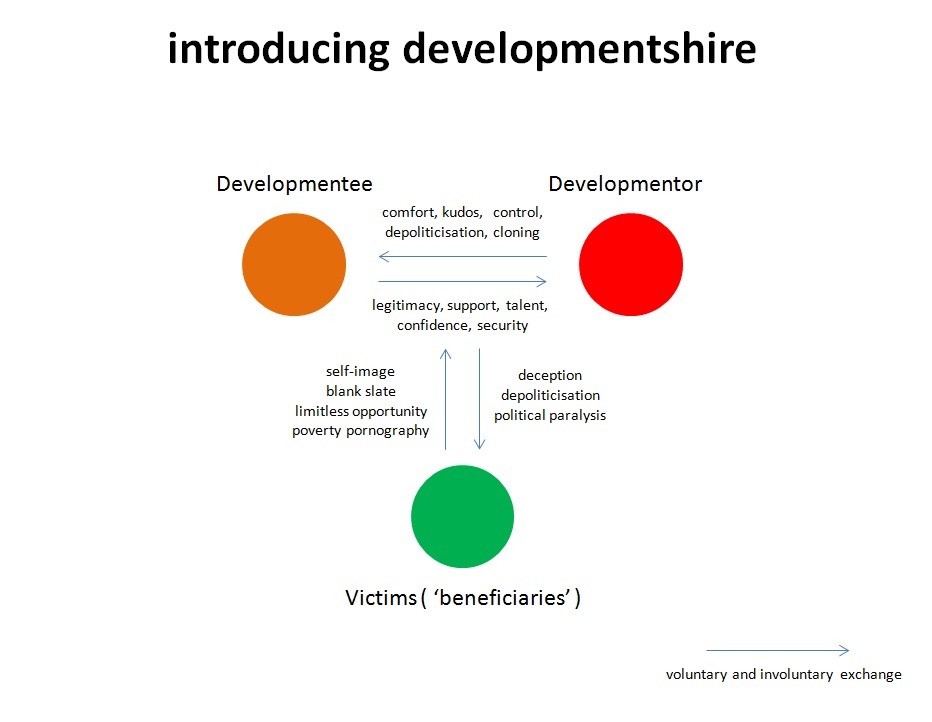
The term petniti, which we use in Bangla to capture the politics (rajniti) of filling one's own stomach (pet), opens up new horizons of  manipulation, which we can call developmentshire. Developmentshire comes into being not just in the conventional case of a donor, an implementing organisation and their hapless victim, but in the of knowledge itself, religion, war and art. 

Developmentshire is a space configured by three main actors [Source: Developmentia Blog].

The region we call Bengal has hosted famines for millennia. In 3rd century BC Mahastangarh (near Bogra) we have evidence of government relief efforts. The intensity of famines upon the arrival of colonial systems of exploitation, and transition states has been of another order altogether, the three most awful of which are
  • The Great Bengal Famine of 1769-70, which unfolded alongside the rise of the British East India Company. 10 million, or a third of the then population is though to have died.
  • The Bengal Famine of 1943, which took place alongside British colonial policies of denial. An estimated 3.5 million lost their lives. 
  • The Bangladesh Famine of 1974 occurred in the context of the aftermath of the Bangladesh war. Some estimate a million died, though the official number is 26 000 [Beware of number politics in this period]. [Source: Banglapedia]


The Resources

Eventually this section will include videos, podcasts, online books, the odd article and hopefully some primary sources.


The Great Bengal Famine, 1769-70


The Bengal Famine, 1943

Jane Austen and the Black Hole of British History [ online text] by G M Polya (2008)

Placing the Great Bengal Famine in the Global Context [online video lecture] by Madhusree Mukherjee (2011)


The Bangladesh Famine, 1974

An Unfashionable Tragedy [online documentary] by John Pilger (1974)


General Famines literature

Poverty and Famines: An Essay on Entitlement and Deprivation [online text] by Amartya Sen (1981)

Ingredients of Famine Analysis: Availability and Entitlements [online text] by Amartya Sen ( 1981)

4.6.11

Why numbers killed in 1971 War and 1974 Famine of Bangladesh really matter

In recent account-makings of killings in Bangladesh during the 1971 war, one of the rhetorics we use is 'numbers dont matter', one person is too many. While this is true, and killing one person is like killing all of humanity, I must beware of the blindness this calculated flattening creates.

If the Bangladesh war killed fewer people than the Bangladesh famine of 1974 then that is a great matter for the people to ponder.

2.11.10

Bengal famine 1943: Churchill's role

Churchill's Secret War by Madhusree Mukerjee (2010)

Is a tome that I am anxious to get my hands on, concerning Churchill's role in the colonially produced atrocity that killed off an estimated three million Bengali people during the 2nd world war. There also the not so small matter of the role of Churchill, the power holder and the rascist mediating the political negotiations for post british India and Pakistan. In the post book analysis, and british counter attack, some interesting questions are raised over the actual benefit of Churchill's existence.

The Famine and other matters lead me to beleive that the British ego and people have been fed a valourised picture of Britain's actions and significance in World War 2.

Here are some resources:

Outlook India article

Independent (London) Review
Hindu (India) Review
Max Hasting's Review in Sunday Times
BBC India Coverage

Dharti ke lal, film by Khwaja Ahmed Abbas (1946)
Ashani Sanket, film by Satyajit Ray (1973)