A terrible sorrowful atrocity has occurred in Bangladesh. It is being covered up so I'm putting together this resource page to make a stable reference point.
There was a massacre of religious protesters at 245am Sunday 5th May around the Water Lily statue in Motijeel, Dhaka's business district. Massive force was used, 10 000 personnel, a whole range of weaponry and darkness.
The deed was committed by a mixture of armed forces: the Bangladesh Police, the Bangladesh Border Guards and the Rapid Action Battalion, which is notorious for 'crossfire'. For the record, the Border Guards have a grisly history, they mutinied a few years ago killing many officers and their families. There will also have been involvement from armed Awami League aligned thugs, like Sohel Rana, whose building collapse killed more than 600 people so recently.
These articles probably appeal to those with time and inclination to read. They may have appeal to nerds like me, and hopefully institutions out there in the world, but in these fast times of facebook timelines and skepticism documentary images have a grounding role to play.
Like. Share. RT. Forward.
Pictures
If you have a Flickr account Feb28.com have a picture library here. This group came into being following an earlier government killing spree. Know that there is danger in looking at these with a heart that yearns for The Spectacle, The Numbers Game and The Competition of Cruelties. These are humans, and what remains, they are sacred and having a sense of the sacred resists the commodification of suffering that neo-liberal capitalism drives. I believe these are innocent men killed in the act of protest against a hegemonic and morally bankrupt regime. It is staggering, that many Bangladeshis, like those on the Blogger and Online Activist Network are still at the point of arguing that these kinds images are all photo shopped, fake and conspiratorial. But think about the dominant national indoctrination processes and narrow historical spoon feeds and it makes more sense.
Pictures tell us a frozen snapshot, whereas human stories go right into us.
Videos
In the video below, a taxi driver secretly films a policeman involved in the massacre,
the policeman describes his view and when the driver asks him if he
feels bad, he expresses no remorse. I pray for the safety of this taxi
driver.
Sometimes people want to hear someone like them tell them the story. In this video log from Dhaka Medical Hospital, A north American development worker, not known for holding sympathies with 'Muslim extremists' bravely puts his life on the line to report on the dead and the dying.
In the last video there are no people, just their blood stains. Lord grant them healing, high station and forgiveness, make us better protection for each other.
So, why is this happening and why isn't anybody doing reporting anything?
This didn't come out of the blue, we saw it coming but the Shahbag spectacle over the past few months was a successful diversion of energy. The government has been arresting non compliant media heads for some time. (Mir Quasem, Mahmudur RAhman). Shortly after the killing spree, the UK-trained Rapid Action Battalion seized the transmitters and shut down Diganta TV and Islamic TV.
The international media is appalling, and embarrassingly it is secular
liberal gatekeepers of Bangladeshi origin are falsely spinning this
story in the BBC (Sabir Mustafa) and Aljazeera (@ShamiminLondon). Just
enough to secure indifference for brown men with beards far away who
dont play liberal.
From facebook I learn that much of the Dhaka urban middle class is in denial. There is a tendency to turn this into a commodified spectacle of numbers and heart crushing imagery of human savagery. The Shahbag aligned have decided that the massacre is all about denying their movement and are acting accordingly. The most prominent facebook group detailing the atrocity, Basher Kellah, is inspired by the Bamboo Fort of Titu Mir, the political-religious reformer who battled landlords and colonialism. It is in dire need of an editorial policy. To be a foolish friend is sometimes worse than being an enemy.
From my point of view I find confirmation that the secular liberal intelligentsia's hegemony is a big, deadly problem. I hope others can see this. Some say they want evidence and without evidence they can't do anything. Sadly, they do not require such evidence when accusing Islamists of heinous crimes with no proper investigation. Crookery, like selective humanitarianism, is rife, especially in the Daily Star, the new Dhaka Tribune, and the Ain o Salish Kendro human rights group.
I call on junior journalists to revolt and leak like Bradley Manning did.
What saddens me even more is how these alien powers in the capital do not regard the religious protesters as proper human beings, have misframed them and their demands, dehumanised them and made it possible for the government to brush-fire them while they prayed and slept in the dark
Some say that Hasina Wajed's government could not have done this without outside approval, and maybe India, USA and/or the UK had some role in this murderous foolishness. After the last coup I wouldn't be surprised. Yet the fact remains that the primary political control rod rests with us, the Bangladeshis, whatever that means anymore.
What shall be done?
Learn how to argue uphill against both brown and white prejudices
Help spread the story, out of respect those who wont be returning to their homes and families and people in future
Engage Awami League School forces in principled debate with superior information and argument.
Lobby elected representatives
Contest unfair reporting
Call out intellectual crooks who infantalise and mislead our people.
Think carefully and creatively about what to do next
Do not allow Hasina, Foreign Minister Dipu Moni, Home Minister Alamgir and company to travel the world without meeting protest.
Prevent desperate Bangladeshi MPs from looting public resources in the last days of their government through their diplomatic privileges.
Yesterday Hefazot-e-Islam (deshi deobandis) and friends marched back to Dhaka to press for their 13 points one month after the Long March which went surprisingly peacefully. I have written about the points in detail in a separate post, yesterdays points were slightly reformulated and included the protection of religious minorities this time. Sadly this time, the government lashed out a full armoury of police, paramilitaries and thugs with deadly effect. Hundreds may have been killed.
Hundreds of thousands, if not a million protesters turned up in a show of seriousness and desire to have their legitimate concerns widely recognised. TalukdarShaheb has published a photoblog of the day as he saw it.
Police, the disgraced and rebranded Border Guards and ruling party aligned thuds, shot at and beat protesters in the day, and in the wee hours of the morning today appear to have prosecuted a massacre in the business district of Motijhil. A friend, by no means an Islamist (...yet) has told me enough from the scene for me not to be able to write it off as bluster from any of the three cyber groups, Basherkella, SaveBangladesh or Feb28.org.
The crackdown has been systematic. The British-trained Rapid Action Battalion has raided and closed Diganta TV and Islam TV channels. I am told that plain-clothes intelligence agents are keeping the countries madrassas under constant surveillance. The Secular liberal establishment, do not regard the attacked as human beings and are too lazy to push back the hand that fed them all their lives.
We might not agree with the protests demands completely but the right to life, assemble, protest and dignity are non negotiable. It is a shame that most human rights warriors in Bangladesh are cowards and strategic with it comes to standing up for the oppressed.
What is to be done and who is to do it?
As ever it depends on our knowledge, position and location.
The moving Prayer of the Oppressed connects us to the divine in a political justice kind of way.
Write to your MP, or other (s)elected representative. If you are from the USA, try to find out if this crackdown was endorsed by them.
Try to establish truth from chaff, avoiding the risk of self-delusions.
Withdraw support for this Government, on family and other scales.
The terrorism industry is often bored and looking for its next hapless victim, do not feed this monster by misframing the Hefazot.
Demand fairer coverage of Bangladesh, make lazy journalists aware of the gate keeper distortion.
Think, act, write, act, dream, act, see, act, seed.
I used to go to Savar to visit the graves of my Khala and Khalu, I guess I passed the site of the building collapse, I think of it as a sad place of dokholocracy, where the MPs and criminals rain injustice and selfishness, with beards, mustaches and clean shaven impunity.
Innalillahi wa inna ilayhi rajiun
More than 200 people have been killed by callousness from the corrupt business-politics nexus in Bangladesh. Thats thousands of people affected, bereaved, orphaned and widowed. In the words of one of the seculib twat I read disregarding the police killings of young Islamists recently, 'thats less than a ferry accident'
Awami League leader Sohel Rana's Rana Plaza in Savar wasn't built to Buliding Code and wasn't evacuated when BUET experts said it wasn't fit for use. The Bank (BRAC Bank) on the two lower floors didn't make its employees come into work on Wednesday, but the garments factories did, under threat of dismissal.
The distribution of distress (worker, bereaved, orphaned) and duress (architect-client, factory-buyer, factory-worker) is discussed with fervour in virtual, professional and business communities.
The Garments owners Association, the BGMEA, have offered 1 lakh Tk (less than £1000) for each of the dead and expelled the five factories.
People are doing what they can to clear rubble, rescue, offer free medical treatment, donate blood and erm, retweet.
Leadership from the top is sorely lacking. This puts a dampener on the governments plan to use the garments workers against Hefazots rally, this makes an anti government, pro transform coalition more possible.
The deeper causes of the dangerous conditions are inherent to the interacting cultures of capitalism that make the garments and construction industries. Blaming Primark must not be a distraction from the politics of more-than-just-cleaning-up, and neither should protecting brand bangladesh, if there ever was such a thing.
I was mulling over the word hifz, which means protection, and the higher objectives, the maqasid, of the shariah, which I've often argued should shape Muslim societies, organisations and selves. They speak of protection and promotion of faith, life, dignity, lineage, intellect and property.
Now Begum Rokeya, Maulanas Bhashani and Madani might be credible moral authorities to invoke when we might imagine a cooperative movement called "Hefazat un Nisa" that secures safety, dignity, family friendliness and vertical mobility to the labour force, in the spirit with which Aminul Islam worked
Far off right? deshi Islamism is pretty indistinguishable from neoliberalism, right?
Maybe now, but was heartening to hear about Farida Akhter's engagement with Hefazat's demands.
Social and corporate media awash,
With depoliticising subcutaneous tosh,
They tell me the Earth of days just has one,
Per solar revolution, ya haqq, what clean fun!
In Zalzala, the Earthquake, we humans might learn,
The value of actions as fossil fuels burn,
See on the Day of His Judgement, she'll speak of our deeds,
Without sponsors watching will we be on our knees?
Words make worlds and actions, contextual small,
They move in between us, burrowing through walls,
So which ones have meaning? and which ones are void,
Of gut clenching reality? which ones are just toys?
Developmentors and developmentees playing with time,
With Internships and nervous ticks they serve up moonshine,
Like "Keep Calm and Save the Earth"
That was vs in worth war 2 for what its worth.
So step away from that leaflet, that advert that graphic,
Atomic weights are what matter, make justice not traffic,
Have a go NGO, waft totemic incense,
I see who you are, I know your pair-rents.
Anti-inspired by some misled tool boys and frequently murderous brother-mines in Nigeria, Boka (stupid) Haram (unlawful) is valuable concept to prevent intellectual retardation upon newly adorning religiosity.
One of the higher objectives of the sharia, is the protection and promotion of intellect, without which stupidistans can only grow, courtesy of the salafi triangle, or pirisms of many a blend.
The Bangla New Year was sung in through Bangladesh, from Dhaka down, with a colourful ritual fervour and much drawing room chatter. In these post Shahbag times and in the last months of the present regime, Pohela Boishakh serves as agrarian symbolic relief for urbanites and a spectacle for cultural nationalist values to wrap around and express.
I guess that during Pakistan times, Boishakh in this form was an important space for opposition cultural forces. Therefore a lot of what we see is a hangover from that period turned into state cultural policy, normalised by much of the middle-class, denuded of meaning by consumerism and historical amnesia, and rejected by competing political frames.
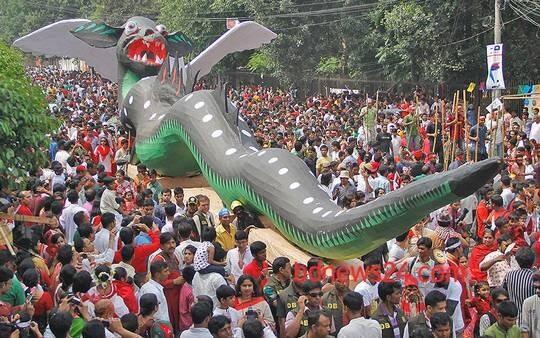
The students of the Charukola Art establishment, as usual, worked hard to create a menagerie of beautiful floats and masks. Some, like the one pictured below kinda scare my pants off. Alas, I should not be afraid, as these are not political aesthetics in translation, snakes are created beings with rights, community and a definitive symbolic roles to play in religious ecosystems.
Source: @danieltweetin
Directed dietary acts, singing, and creativity create a political self, they are important to understand and resculpt if we are to produce an active political and spiritual self.
All to often we can miss the point altogether. In the words of national treasure Hyder Husyn, a pious folk-rocker with social conscience, reflecting on national independence in his wonderful song 30 Bochor (Years)
Does freedom mean eating slightly fermented rice and hilsa fish at Bangla New Year Fairs?
Does freedom mean sitting under the banyan tree and singing Bangla New Year songs?
Music isn't haram, especially this.
My favourite, constructive contribution was the senior water sector engineer Inamul Haque's (re)call for the fiscal year to start and end around Bangla New Year. This single bureaucratic change would enable the success of all engineering works in Bangladesh, by scheduling expenditure and physical development works away from flood times and denying a whole lot of excuse-making. Peoples lives, homes and livelihoods would be better protected from river erosion, coastal erosion and flood, who knows the possible beneficial impacts on land making and other sectors.
Muhajirs from Boishakh?
Like many other calenders in the region that bear ethno taglines, the Bangla calender draws from King Akbar's solarisation of the lunar Hijri calender that marks RasulUllahs migration to Medina from the oppression of Makkah. Visiting the cities for Hajj last year it was like divine geological poetry that Makkah resembled a clenched fist and Medina an open palm.
I don't buy the universal pretensions of status quo Boishakh. From inside and outside of me I observe that it is aesthetically and politically alienating of differently Islamically inclined political subjects of the state, who annually chafe through the day like a haji in an ihram on a hot day with inadequate ventilation. Yet the 'Boishakh as Hindu Culture' pejorative, though understandable, doesn't generate any creative work and worse still distracts the Muslim from the cultural stagnancy of Islam in Bangladesh.
Its not that young folks aren't interested in Islah, more that there are insufficient socio-cultural guides, audiences and spiritual-political protections to enable the processes of self-discovery and awkward experimentation.
This morning I watched a few videos from the folks at ibana group, these were pretty cute and were produced well. My heart screamed mashallah, my head retorted Salafi Triangle, but my practical sensibility respects how much this is relevant to the religious literacy issue in Bangladesh. The Maher Khan story depicts the journey of a middling heavy metal guitarist away from his music into a non musical 'more' Islamic present. Personally, I am hungry for a re-imagined metal that thrashes the forces and structures of injustice, tyranny and consumer capitalism, and pray that we haven't heard the last of Maher bhai. Maybe I should stop living vicariously through the lives of others.
If you were wondering about The Salafi Triangle, it is a shorthand for why a lot of Islamic works have taken their present shape. The frame is intended to explain, not detain.
Pantha bhat is to Boishakh, what Piaju is to Ramadan
On the subject of analysis of the political and Islamic self, lets talk about Ramadan. This year Ramadan will arrive around 9th July and take us through to the beginning of August, as ever it is what we make of it and we'll be sorry to see it go. This won't be a relevelation to some but, much of what has happened to Boishakh has happened to Ramadan, political reduction, consumerisation and mattabarisation. It would appear that the middle-class probably has a lot to answer for.
Boishakh: Pantha bhat, ilish mas and green chilli
Reclaiming Ramadan from the market, state and mislamist liberates the Muslim self, and makes fresh deeds and pieties possible. Taqwa and deeds make eachother, which is where grounded activism is critical and dynamic religion is so potent, which scares the pants off the seculib establishment. The month is a training ground for moral athletes, not a grounds for buffet, social inbreeding, and bureaucratic robotarawi.
Pretty words ey? What about results? It is very possible, as has been demonstrated over some years, to battle gluttony and the consumerisation of Islam together to establish a lightning rod for artistic, spiritual and socio-political creativity. Folks in Malaysia have taken up the idea I believe.
There is much meaning to make, after all Islamic Time flows though Political Time. As the lunar calender cannot sit in one place, it tracks around the solar year in 30 year cycles, giving us a historical kaleidoscope onto our pasts which disrupts Political Partisan Time.
I love this game, the intermediary Pakistani state was declared on Layla tul Qadr, the Night of Power, and the Bangladesh War ran through a Ramadan in late October through to November 71. Do we know enough about practices and feelings in those times?
Labouring the point one last bit, we may balk at Boishakh but how hopening are we making the Ramadhan experience? After all, the Islamic or not Islamic character of the republic, is a reflection of the state of hearts of the people.
.
As the Deoband-Madani oriented Hefazat ul Islam's points of contention and (intentionally) limited scope still ringing around society in Bangladesh, the place, potential, translation and movement of Islamic socio-political principles and shapes comes to attention.
With today's arrest of Amar Desh's editor and past BNP energy adviser Mahmudur Rahman, and the sealing of its press, the dissenting voice of 'Islamic forces' has been muzzled. I remember how Amar Desh broke the TribunalGate story in December that sent the War Crimes Tribunal into a headspin and magically began the corrosion of 42 years of powerful guilt tripping and rumour mongery that has made a self-mutilating laughing stock of the country.
That said, I don't think he is the Mahdi or the Sonar Bangla Bullet. I pray he is returned safely to his family ASAP (just like everyone else who is unjustly confined) and see this arrest as just one part of the actions of a despicable, dissent-crushing and murderous government. I just wanted to take the moment to ponder beyond dinosaurs, clones and religious tribalisers.
The more I think of the political autisms of Shahbag and and LongMarch the more I feel that we need to reconnect, critically, with the politics of Maulana Bhashani, the 80 day president Khondhokar Moshtaque Ahmed, and the erudition of Kamal Hossain. [The Kissinger Cables hyperlinked provide a one-click time machine to them]
It is sad that the country is probably not even hungry for a creative generation of Islamic thinkers, justice and serenity makers. The tail end batsmen can only last for so long, especially now that they have acquired a habit for self harm.
Imagine
A public sphere more inclusive of Islamic and other non secular contribution and social imagination.
Hefazat-un-Nisa, a radical Islamist Begumhood dedicated to ensuring dignity and a living wage for garments workers, male and female and the vibrancy of the sector.
The country's apparently Islamic types inspired by the work, talent and martyrdom of Shaheed-e-Kormi Aminul Islam .
Political formations and actions that rupture the firewalls between rightist-Islamist and leftist-Atheist.
A Jamat happy to admit mistakes and nuance and Islamic alternatives.
A left that is co-operative with political Islam.
Greater dialogical relations between Islamic, social and physical sciences and scholars.
A vibrant, Islamically moved creative class providing social yeast, not decoration or nostalgia.
A world-class weekly publication to carry the conversation and raise the tone.
That the judiciary had integrity.
That talents would be nurtured and given scope, not hamstrung, embittered and cleft asunder.
In the coming years there are fewer blockheads in every camp.
A new political grammar to supercede hartals, encampments, marches and naff renditions of whiteous indignation.
Ecological politics, not confrontational politics.
Bangladesh as an ummahtic destination for more than the Tabligh, Tawfique Chowdhury and Zakir Naik.
Real, confident and credible engagement in the Asian regional scene.
Source: Facebook Full Transcript of Rached Ghannouchi’s lecture on Secularism – 2 March 2012
Mr. Rached Ghannouchi, President of the Nahdha Party in Tunisia, gave an important and historic lecture at CSID-Tunisia last Friday, March 2nd, on « Secularism and Relation between Religion and the State from the Perspective of the Nahdha Party », which was then followed by a frank and open debate with leading scholars, activists, civil society leaders, and politicians from accross the full spectrum, as well as representatives of the Moroccan, Algerian, Egyptian, and American diplomatic missions.
The audience also included the Head of the Constituent Assembly Mustapha Ben Ja’afar, President of ALESCO Muhammad Al-’Aziz Ibn ‘Ashour, the Head of the Higher Committee for Human Rights and Fundamental Freedoms in Tunisia Noureddine Hachad, as well as the leaders of various political Parties such as Muhammad Goumani, Abd Al-Wahhab Al-Hani, Murad Ruissi, Muhammad Busairi Bouabdelli, and Khaled Traouli.
Transcript of Rached Ghannouchi’s speech:
In the name of God, prayers and peace be upon His Messenger, his household, companions, and supporters.
Ladies and gentlemen, brothers and sisters may God’s peace and blessings be upon you.
I thank the Centre for the Study of Islam and Democracy for giving me the opportunity this evening to speak to this distinguished elite of Tunisian men and women and those coming from abroad. I am not here to teach you anything, since the subject we are here to discuss has no set instructions to be delivered but rather only points of view to be deepened and efforts to reach a common ground that would enable our elite to reach a consensus or at least a quasi-consensus.
Our topic is quite problematic in the sense that it deals with the Islam’s relationship to secularism. Is this relationship one of conflict and discord or one of harmony and overlap? Related to this question are issues such as Islam’s relationship to governance, the relation between Islam and Law, which are all contentious matters.
It seems that when we speak of secularism and Islam, as if we are talking about evident and clear concepts. However, a non-negligible amount of ambiguity and multiplicity of understandings surround these concepts, in that we are not talking about ‘a’ secularism but rather a multitude of secularisms as is the case with Islam, by virtue of what is proposed in the arena, we are faced with various understandings of what it means.
Although secularism seems as if it was a philosophy and the fruit of philosophical reflections and meditations which came to fight idealist and religious outlooks, it is not so. Secularism appeared, evolved, and crystallized in the West as procedural solutions, and not as a philosophy or theory of existence, to problems that had been posed in the European context. Most of these problems emerged following the Protestant split in the West, which tore apart the consensus that had been dominant in the Catholic Church, and imposed the religious wars in the 16th and 17th century. It was thus that Secularism and/or secularization began.
This leads us to ask the following question: are we in need of secularism in its procedural aspect? Perhaps the most important idea in the ensemble of these procedures is the idea of the state’s neutrality i.e. towards religions and its abstention from interfering with people’s consciences. Whereas, the state’s scope or jurisdiction is limited to the ‘Public Domain’, religion’s scope extends to the ‘Private’. In the United States religious interference in the public domain is evident, despite the differentiation that exists there remains a significant religious influence. Their leaders’ speeches are laden with religious content and references, and religion is debated in all electoral campaigns where it manifests itself in issues such as prayer in schools and abortion. This in reality is due to the fact that America was founded by evangelical pilgrims fleeing with their religion from the Catholic Church’s persecution in Europe. It is for this reason that the U.S. is looked at as the Promised Land, the land of dreams mentioned in the Torah and Gospels.
As the Franco-American thinker Tocqueville once remarked that the Church is the most powerful party in the United States. This is by virtue of the huge influence that it enjoys, though this is not the case in Europe. Whereas the number of those who can lead prayer in the US exceeds 50%, in Europe it does not reach 5%.
In the European context, also, there are differences in the state’s relationship with religion between the French heritage and Anglo-Saxon one, whereby in the UK the Queen combines the temporal and the religious powers. The complete separation is the one that is associated with the French experience, which resulted from the clashes that took place in French history between the revolutionaries’ state and the Catholic Church. Even in Europe, therefore, we are not dealing with one experience in secularism, perhaps for our purposes, since our elite is influenced by the particular French perspective (particular even for Europeans) where religion is totally excluded from the public sphere and the state considers itself as the sole guardian of national identity. This exclusion of the religious and its symbols from the public domain is what lead France to be the only country that refused the covering of heads for Muslim women, while we don’t see such a crisis in any other European country over the issue of headscarves. This is exclusively due to the particular nature of the relationship between state and religion in France which was the result of a particular historical experience.
We in turn are not faced with one understanding; perhaps the most important procedure invented by the secular worldview on this level is the state’s neutrality. In other words, the state is the guarantor of all freedoms be them religious, political or otherwise. And the state should not interfere in favor of this or that party. We pose the following question now: Is Islam in need of such a procedure? i.e. the state’s neutrality towards the various religions.
Islam, since its inception, has always combined religion with politics, religion and state. The Prophet (peace be upon him) was the founder of the religion as well as the state. The first pledge of allegiance made by the group of Madina who came to Mecca was a religious pledge to believe in Allah and his Messenger. But the second pledge was to protect the Muslims, even by sword, should al-Madina be attacked. Al-Madina, and this expression is of the utmost importance, used to be called Yathrib before becoming Al-Madina (The City) which implies that Islam is not merely a religion but also carries a civilizational meaning. It is a transferring of people from Bedouin life to urban/civilizational life. This is why ‘Bedouinization’ was considered a great sin once urbanization had been achieved. No wonder then that wherever Islam went it established cities and our country hosts the oldest city built by Arabs in North Africa. Therefore, The City founded by the Prophet (pbuh) is a clear indication that Islam is a religion of civilization, whereby it shifted those warring tribes from a Bedouin level to a civilized one and united them around a state.
The Prophet (pbuh) was a an imam in the religious sense as he lead prayers in mosques, and at the same time a political imam that arbitrated people’s disputes, lead armies, and signed various accords and treaties. Of relevance to us is the fact that upon his arrival to Medina he established a mosque and put in place a constitution that was called Al-Sahifah. You have precedents here Mustapha! [In reference to Mr Mustapha Ben Ja'afar, President of the Constituent Assembly, who was present in the audience]. This Sahifah, which is one of the oldest constitutions in the world, contained a bundle of covenants regulating the relations between Meccan immigrants and their hosts (these were considered as one nation) and the Jewish tribes of Madina (also considered a nation). Al-Sahifa considered these two religious nations as comprising one political nation and entity that is distinct from others. The most important concept offered by such scholars as Muhammad Salim Al ‘Awwa and Muhammad ‘Umar is the distinction between the religious and the political as corresponding to the separation between state and religion.
The distinction between that which is political and that which is religious is clear in the Sahifah in that Muslims are a religious nation (ummah) and the Jews another, but the combination of the two plus other polytheists made up a nation in the political sense. This distinction can be witnessed in the Prophet’s dealings even if the boundaries were not always clear. Whereas the religious is the sphere of observance and obligation, the political is the sphere of reason and Ijtihad. At times when the ambiguity confused the companions, they would ask the Prophet (pbuh) whether this is divine revelation (wahy) or a mere opinion. In the case of the former they would obey, and when it is the latter they may differ and offer alternatives. On more than one occasion did the companions differ with the Prophet (pbuh) in his capacity as the head of state, and Sheikh Tahar Ben Ashour has dealt in detail with the topic of what he called ‘Prophetic Statuses’.
One day the Prophet (pbuh) passed by a group in Medina cross-pollinating palm trees and said: ‘I do not see the benefit of doing so.’ The Medinan people thought that that was divine revelation and stopped treating their trees which made their harvest of that year of a lesser quality. They asked him why he ordered them to do so, and he replied: you are best placed to know what is beneficial for you in your worldly affaires. Therefore, it is not the duty of religion to teach us agricultural, industrial or even governing techniques, because reason is qualified to reach these truths through the accumulation of experiences. The role of religion, however, is to answer the big question for us, those relating to our existence, origins, destiny, and the purpose for which we were created, and to provide us with a system of values and principles that would guide our thinking, behaviour, and the regulations of the state to which we aspire.
So, Islam since its inception and throughout its history has not known this separation between state and religion in the sense of excluding religion from public life. And Muslims, to this day, have been influenced by Islam and inspired by its teachings and guidance in their civic life, with the distinction remaining clear. This distinction between the religious and the political is also clear in the thought of Islamic scholars/jurists. They have distinguished between the system of transactions/dealings (Mu’amalat) and that of worship (‘Ibadat). Whereas the latter is the domain of constancy and observance i.e. reason cannot reach the truth, the former is the domain of searching for the general interest, for Islam came to realize people’s interests as confirmed by such great jurists as Al-Shatibi and Ibn ‘Ashour. These scholars have agreed that the highest objective of all divine messages is to establish justice and realize people’s interests, and this is done through the use of reason in light of the guidelines, objectives, values, and principles provided by religion. Thus, there is a domain of transactions/dealings which is constantly evolving and represents the sphere of variables, and there is the domain of creed, values, and virtues which represents the sphere of constants.
Throughout Islamic history, the state has always been influenced by Islam in one way or another in its practices, and its laws were legislated for in light of the Islamic values as understood at that particular time and place. Despite this, states remained Islamic not in the sense that their laws and procedures were divinely revealed, but that they were human endeavours open to challenge and criticism. States have also practiced a degree of neutrality, and when they tried to interfere and impose one understanding on Muslims, as happened in the Abbasids state, it sparked revolution. It is mentioned that al-Mansour had become concerned with the multitude of religious views and interpretations emanating from the same religion and feared their divisive effect on the state. So he sent for Imam Malik and asked him to amalgamate all these in one to unify people’s outlooks. Imam Malik produced his famous book al-Muwatta’, with which al-Mansour was greatly pleased and wanted it to become a law that binds all Muslims. This horrified Imam Malik and asked for it not to be made so, because the Prophet’s companions have travelled to different lands and took with them much knowledge, so allow people to choose what they see fit. This is why we see that one school of thought is dominant in the Maghreb, while another is so in the Levant, and yet another in Egypt…etc
It is due to the absence of a church in Islam that what remains is the freedom of thought and interpretation. This will naturally lead to a diversity in interpretation, and there is no harm in that except when we need to legislate, at which time we are in need of a mechanism, and the best mechanism that mankind has come up with is the electoral and democratic one which produces representatives of the nation and makes these interpretations a collective as opposed to an individual effort. Again, in the absence of a church representing the sacred on earth and a spokesperson of the Qur’an, the nation is the only manifestation of divine will through its interactions and not any particular scholar, party, or state.
When al-Ma’moun (Abbassid Caliph) wanted to impose one interpretation of the Quran and one particular understanding of Islamic creed (that of the Mu’tazili school), Imam Ahmed Ibn Hanbal revolted and refused the state’s attempt to dominate religion. This lead to him being persecuted and tortured, but in the end he managed to turn public opinion against the state and force al-Ma’moun to cede.
While the problematique in the west revolved around ways of liberating the state from religion and lead to destructive wars, in our context the problem is one of liberating religion from the state and preventing it from dominating religion, and keeping the latter in the societal realm, open to all Muslims to read the Qur’an and understand it in the manner that they deem appropriate, and that there is no harm in the plurality that is combined with tolerance. But should Muslims be in need of laws, the democratic mechanism is the best embodiment of the Shura (consultation) value in Islam.
It is of the utmost importance that our heritage is devoid of a church. Maybe only our Shi’ah brothers hold the belief in a religious institution, but in the Sunni world there is no such a thing save for a council of scholars which are usually in disagreement and hold different views. For this reason, we are in need of scholars and intellectuals to debate and study our issues in a climate of freedom and accept that the legislative institution is the ultimate authority by virtue of being elected.
There is a debate that is currently ongoing in our country between secular currents which may be described as extremist and Islamist ones which may be described in like manner. One would like to impose their understanding of Islam from above using state tools and apparatuses and the other aspires to strip the state, educational curricula, and national culture of all Islamic influences. At a time when the whole world, including the Islamic world, is witnessing a religious awakening, and having seen the role played by the Catholic Church in the development of Eastern Europe, starting with the efforts of Pope John Paul II, and also the role of the Russian Orthodox Church in the success of Putin’s presidential campaign. At such a junction in time, it is unreasonable to object to religious influence on the state’s cultural and educational policies. In fact, we do not need do impose Islam because it is the people’s religion and not the elite’s, and Islam has not endured for so long because of states’ influence but rather due to the large acceptance it enjoys among its adherents, in fact the state has often been a burden on religion.
As I said, many of those who belong to the Islamist current and others fear the religion’s emancipation from the state to be left as a societal matter. Why does the state train Imams? Why does it control mosques?
The issue of the state’s neutrality involves a great deal of risk and adventure. If what is meant by the separation between religion and state is that the state is a human product and religion a divine revelation as the distinction was made clear in the context of the early Muslims between the realm of revelation (wahy) and what was the realm of the political, then it is ok. But if what is mean is the separation in the French sense or in accordance with the Marxist experience then we may engage in a dangerous adventure that may harm both religion and state. The total stripping of the state from religion would turn the state into a mafia, and the world economic system into an exercise in plundering, and politics into deception and hypocrisy. And this is exactly what happened in the Western experience, despite there being some positive aspects. International politics became the preserve of a few financial brokers owning the biggest share of capital and by extension the media, through which they ultimately control politicians.
In this context, people are deeply in need of religion and its spiritual and moral guidance which would enable them to distinguish between right and wrong (halal and haram). And in the absence of a Church that monopolises the definition of what is halal and haram, this task is left to be debated by the elite of thinkers, the people and the media.
Should religion be entirely emancipated from the state and politics, this would also carry some risks whereby things would get out of control and social harmony would be endangered. The way to do it, therefore, is to find a balance that would guarantee people’s freedom and rights, because religion is here to do exactly that. To achieve this balance, we need to go back to the issue of distinguishing between religion and politics and adjust the parameters of what is constant in religion and that which is variable. We need our legislators to be well acquainted, educated and versed in religious values, so that when they are legislating they do not require the tutelage of religious scholars and authorities, and the same goes for politicians. There is no value to any religious observance that is motivated through coercion. It is of no use to turn those who are disobedient to God into hypocrites through the state’s coercive tools. People are created free and while it is possible to have control over their external aspects, it is impossible to do so over their inner selves and convictions.
This is exactly why we saw two models in dealing with issue of the headscarf/veil, the first is a veil that is dictated and imposed by the state and the second is a veil forbidden by it. Once I was in a Muslim country’s (in reference to Saudi Arabia?) airport where all women were covered, but as soon as the plane took off the veils flew away with it. This is a clear failure of that country’s educational system, which was unable to guarantee people’s religiosity except through coercive tools. In Ben Ali’s Tunisia, women were forbidden from wearing the veil and express themselves in whatever appearance they saw fit, also through the state’s coercive means. This was also a failure.
The primary orbit for religion is not the state’s apparatuses, but rather personal/individual convictions. The state’s duty, however, is to provide services to people before anything else, to create job opportunities, and to provide good health and education not to control people’s hearts and minds. For this reason, I have opposed the coercion of people in all its forms and manifestation and have dealt with such controversial topics such as al-Riddah (apostasy) and have defended the freedom of people to either adhere to or defect from a religious creed, based on the Qur’anic verse that says: ‘there is no compulsion in religion’.
There is no meaning in forcing people to become Muslims, the Muslim nation has in no need for hypocrites who manifest belief and conceal disbelief. Freedom is the primary value through which a person adheres to Islam, so he who announces his shahadatayn (‘I declare that there is no God but Allah, and Muhammad is his final Messenger’) does so on the basis of free choice underpinned by awareness and conviction. In this manner, the state is Islamic insofar that it assures its actions are in accordance with Islam’s values without being subjected to the tutelage of any religious institution for there is no such a thing in Islam. Rather there is a people and a nation who are the decision makers through their institutions.
When the Meccan people objected to Muhammad’s religion, he asked them not to interfere with his preaching activities and to allow him the freedom to communicate his message to the people. Had the Meccans accorded the Prophet (pbuh) the freedom of expression, he would not have immigrated and left his homeland. But because his message was so powerful, they could not offer an alternative to counteract it. This is why Muslims consider Islam’s proof to be so powerful that there is no need to coerce people, and when the voice of Islam proclaims ‘Produce your proof if ye are truthful’ this challenge is being proposed at the heart of the political and intellectual conflict.
Thus, the greater part of the debate taking place nowadays in our country is a misunderstanding of such concept as secularism and Islam. We demonstrated that secularism is not an atheist philosophy but merely a set of procedural arrangements designed to safeguard the freedom of belief and thought as Abd al-Wahhab al-Masiri distinguished, in his writings, between partial and total secularisms. An example of the latter would be the Jacobin model in French history. In their war on priesthood, the Jacobins’ raised the following slogan: « strangle the last king with the entrails of the last priest. » This is a French specificity and not the absolute definition of secularism. There is also an ambiguity regarding Islam, for there are those who believe that Islam can only be victorious by confiscating people’s freedom and imposing prayers, fasting, and the veil through force. This would be far from being a success, for Allah Almighty had considered hypocrisy to be the greatest crime, and the hellfire to be the eternal abode of Hypocrites.
The fact that our revolution has succeeded in toppling a dictator, we ought to accept the principle of citizenship, and that this country does not belong to one party or another but rather to all of its citizens regardless of their religion, sex, or any other consideration. Islam has bestowed on them the right to be citizens enjoying equal rights, and to believe in whatever they desire within the framework of mutual respect, and observance of the law which is legislated for by their representatives in parliament.
This is my understanding of things, and my view with regards to Islam’s relation to secularism. I hope that I have touched on the main issues, and I thank you profusely for your attention.
Transcribed and translated by: Brahim Rouabah/CSID