Showing posts with label decolonialecopolitics. Show all posts

11.10.24

Butch Ware and the US Green Party are helping to open a Decolonial Wormhole to a Better World

Its crucial to demonstrate electoral consequences for genocide.

Today, somebody wise sent me an interview of  Prof Bilal Rudolph "Butch" Ware on the Ansari Podcast. He is the Green Party's Vice Presidential Candidate for the forthcoming US Presidential Elections. To me his words and method are a vital alignment of thought, political spirituality and organising backbone that I find compelling. funny how in the UK, his nonsecular meter would be outlawed for some colonial 'spiritual influence' lawfare. 

The video is embedded below, Nur Nuggets include:

  • Democrat Party as Party of the Elephant.
  • Republican Party as the Party of the Braying Ass.
  • The political aesthetic of a green hoopoe.
  • The importance of being ready.
  • The Democrats theft and gutting of the Green New Deal policy.
  • The recent youth led movement in Bangladesh as a teaching lesson of our times.
  • The things that can be done in the case of the team winning presidential office and no friends in Congress or Senate. Anti Trust suites and arms embargo on Israel.
  • A poll based argument on why the Party of the Elephant have lost already.
  • Plenty of policy reasons for voting for them.
  • Good humour about the struggles ahead in any eventuality.
  • Their independence from AIPAC and arms industry.
  • Anecdote of convincing Republican voters to organise a rally for his party.
  • The measures that the Two Party duopoly, Dems especially, have taken to prevent them accessing the voterhood.
  • Podcast host's inevitable endorsement for black seed oil, apple cider vinegar, honey gummies from a Palestinian woman. [fractal of the whole thing]


Prof Ware's doctoral research was on the anti slavery resistance of West African Islamic scholars and he has more recently been organising with students and teachers against the Israeli-US genocide in Gaza and beyond. He is based at the History Department of the University of California Santa Barbara.

People in most states of that country have an option to vote against the Zionist's slaughter, with a decolonial ecopolitical horizon. That is a commitment of environmental and social justice that centres coloniality as the systemic foe. Prof Ware has brilliant moves, at least in the domain of discourse. Political proof will be in the struggles and relationships. I really hope they do well, that their supporters and workers do well and make the most of this, for the sake of the Palestinians, wider West Asia, themselves and all of us. Decolonial Duas for them and us all.

If Ware's political content and method resonate with you, he's been on Breakfast Club , Bad Faith, Democracy Now! and will be speaking to reach Trump voters ( ?!?) over the coming weeks.

There is a lot at stake in this election, this devastating year has exposed a lot of people's true colours and functions. So what will it be? Green Hoopoe or Green Card?




23.12.16

Bengal Famines Resource Page

It is hard to imagine the suffering and degradation of famine and how it continues to transform the spiritual, technological and intellectual traditions and futures that we nurture.  When I read about famines of Bengal, at one level I wonder about all the friends and relatives I am missing out on, but also now the learning and teaching value of these disasters and what they demand of the decolonial eco-politics that remains in our dreams. 

It is a peculiar, dizzying and colonial wound and bind. So I'm putting together this work-in-progress resource page to raise awareness, and creative resistance to the criminal individuals and infrastructures of arrogance celebrated by the new five pound note pictured below. 


Progress is wider and higher recognition of the Bengal Famine of 1943 in the story Britain tells itself and the world about World War 2. I do not celebrate indentured foot soldiers of white supremacy as British Asian or British Indian or British Muslim history worth celebrating, though I wish them well in the afterlife.

Petniti: The Practical and Epistemic politics of hunger 

A lot of decision-making still occurs in the mental shadows of famine. From adopting problematic agricultural technologies pushed at us as solutions to famine and climate doom, to acquiescing to tyrannical political relations just to survive/thrive, from falling into overpopulation-thinking, to taking that job that probably messes the world up further. Putting food on the table has a different meaning when political, economic and nutritional stunting is so apparent. Its even in the language.

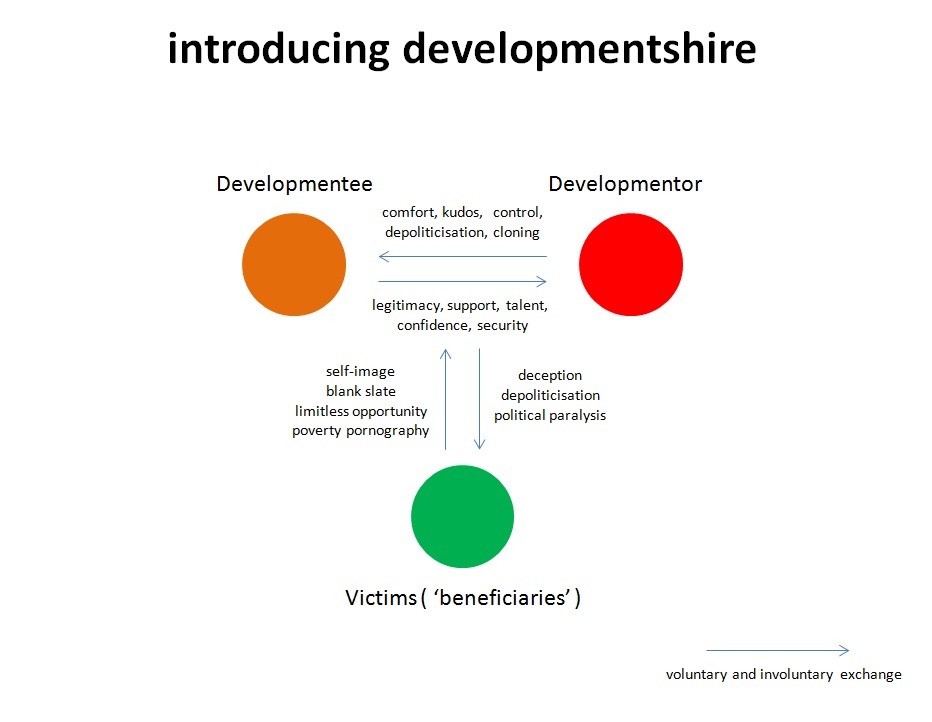
The term petniti, which we use in Bangla to capture the politics (rajniti) of filling one's own stomach (pet), opens up new horizons of  manipulation, which we can call developmentshire. Developmentshire comes into being not just in the conventional case of a donor, an implementing organisation and their hapless victim, but in the of knowledge itself, religion, war and art. 

Developmentshire is a space configured by three main actors [Source: Developmentia Blog].

The region we call Bengal has hosted famines for millennia. In 3rd century BC Mahastangarh (near Bogra) we have evidence of government relief efforts. The intensity of famines upon the arrival of colonial systems of exploitation, and transition states has been of another order altogether, the three most awful of which are
  • The Great Bengal Famine of 1769-70, which unfolded alongside the rise of the British East India Company. 10 million, or a third of the then population is though to have died.
  • The Bengal Famine of 1943, which took place alongside British colonial policies of denial. An estimated 3.5 million lost their lives. 
  • The Bangladesh Famine of 1974 occurred in the context of the aftermath of the Bangladesh war. Some estimate a million died, though the official number is 26 000 [Beware of number politics in this period]. [Source: Banglapedia]


The Resources

Eventually this section will include videos, podcasts, online books, the odd article and hopefully some primary sources.


The Great Bengal Famine, 1769-70


The Bengal Famine, 1943

Jane Austen and the Black Hole of British History [ online text] by G M Polya (2008)

Placing the Great Bengal Famine in the Global Context [online video lecture] by Madhusree Mukherjee (2011)


The Bangladesh Famine, 1974

An Unfashionable Tragedy [online documentary] by John Pilger (1974)


General Famines literature

Poverty and Famines: An Essay on Entitlement and Deprivation [online text] by Amartya Sen (1981)

Ingredients of Famine Analysis: Availability and Entitlements [online text] by Amartya Sen ( 1981)